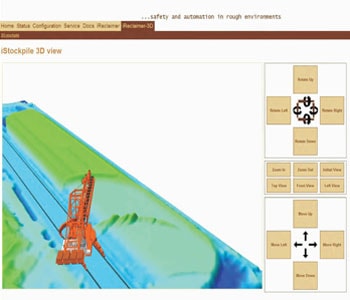
Intelligent Machine Automation for Steel Manufacturing Operations

The Machine Automation System by Hind Industec Private Limited represents the future of industrial control through integrated vision-based technology, precision positioning, and intelligent automated operation. Our comprehensive automation solution addresses human limitations in production environments - including visibility constraints, manual instruction errors, fatigue, and distraction - by implementing fully automated control systems that deliver better, faster, more flexible, and accurate production operations.

Vision-Based Automation Technology

Many key tasks in production environments - including inspection, orientation, identification, and assembly - require visual techniques. While human vision excels in versatility, human weaknesses limit productivity. Our machine automation system combines advanced 2D/3D scanning technology with GPS-based precision positioning to create totally integrated automation that overcomes these limitations, enabling unmanned operations with superior accuracy and consistency.

Overcoming Human Limitations Through Intelligent Automation

Production tasks requiring inspection, orientation, identification, and assembly traditionally rely on visual techniques where human vision provides versatility but introduces limitations. Visibility constraints, eye estimation inaccuracies, manual instruction dependencies, boredom, distraction, fatigue, and inconsistency can degrade human performance in production environments. Totally integrated machine automation addresses all such human weaknesses. The Hind Industec automation system represents the first step toward better, faster, more flexible, intelligent, and accurate production operations through advanced vision-based control and automated decision-making.

Automation Technology
System Features
Operational Benefits
Machine automation technology for steel plant equipment with vision-based control and GPS positioning

Fully Integrated Automation Control

Based on work orders generated by operators in the control room, the RMMS software calculates all required positions including linear travel distance, slew angle, and luff angle of booms according to stacking or cutting instructions, then sends these instructions to the PLC. The machine automation system automatically moves equipment to calculated starting positions and executes jobs according to programmed instructions without manual intervention.

The iRRU (Intelligent Remote Reference Unit) connects to 2D radar systems (used for stock profiling) and D-GPS units (used for monitoring physical machine conditions). Operations are continuously monitored and calculated by iRRU with calculated data sent in parallel to PLCs. As soon as operations reach desired results, PLCs trigger stop signals to halt operations precisely at target positions.

Operators cannot realistically measure distances to pile faces or cutting depths with visual estimation alone. Small differences of even one meter significantly impact operations. Traditional operators drive by feeling, judging vibrations, and waiting for slewing out of piles. Our automated control system provides real-time, highly accurate information on cutting span depth, detects bench edge heights to automate stacker boom return movements, and offers numerous other monitoring options for precise, repeatable operations.

Key Operational Benefits:

  • Pile dressing optimization: Adherence to standard operating procedures and avoidance of uneven surfaces
  • Storage capacity maximization: Increased storage capacity and improved reclaiming performance
  • Full resource utilization: Complete utilization of equipment and stockyard space
  • Predefined stacking methods: Windrow, Chevron, and Cone shell configurations
  • Equipment protection: No over-torque of machinery or overloading of conveyor belts
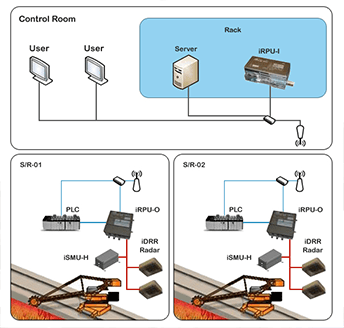
Machine automation system features including 2D 3D scanning and GPS positioning technology

Advanced System Features

  • High-accuracy scanning: 2D profile and 3D scanning technology for precise positioning
  • Environmental resistance: Insensitive to dust, vibrations, wind, fog, snow, rain, and thunderstorms
  • Real-time updates: Constant model updates at 15 Hertz measurement frequency
  • Industrial durability: IP66 rated industrial enclosure for harsh environments
  • Precision positioning: Contact-less measurement of luff and slew angles using D-GPS with precision accuracy
  • Unmanned operations: Safe and secure man-less operation capabilities
  • Inventory integration: Exact inventory control and tracking
  • Automated control: Complete integration with PLC systems for autonomous operation

Comprehensive Operational Advantages

  • Increased throughput: Higher production rates through automated operations
  • Better stockyard utilization: Optimized use of available storage space
  • Complete visibility: Improved stockyard visibility from arrival through dispatch
  • Enhanced decision making: Data-driven operational decisions across multiple stockyards
  • Smooth integration: Seamless plant integration with existing systems
  • Minimal maintenance: Reduced maintenance and cleaning requirements
  • Operator efficiency: Maximized operator productivity through automation
  • Accurate visualization: Precise 2D/3D snapshots of stockyard conditions
  • Real-time measurement: Continuous measurement during normal operations
  • All-weather operation: Operable under all environmental conditions
  • Collision avoidance: 3D anti-collision systems preventing costly errors
  • Error elimination: Eliminate air reclaiming, ground digging, and improper loading
  • Complete statistics: Full production history and statistical analysis
  • Optimal allocation: Intelligent zone and section allocation in stockyards
  • Improved planning: Better stacking and reclaiming strategies

Frequently Asked Questions About Machine Automation

What is vision-based machine automation?

Vision-based machine automation uses advanced 2D/3D scanning technology combined with GPS positioning to automate industrial equipment operations. The system replaces human visual inspection and manual control with precise, automated positioning and operation, eliminating errors caused by visibility limitations, fatigue, and inconsistency.

How does automated control improve steel plant operations?

Automated control systems provide precise positioning, eliminate manual estimation errors, enable unmanned operations, increase throughput, optimize resource utilization, prevent equipment damage through anti-collision systems, and maintain consistent operations regardless of environmental conditions or operator fatigue.

What equipment can be automated with this system?

The machine automation system can automate stacker-reclaimers, bucket wheel reclaimers, ship loaders/unloaders, conveyor systems, and other bulk material handling equipment. The system provides automated stacking, reclaiming, cutting depth control, boom positioning, and anti-collision protection for any combination of equipment.

How accurate is the 2D/3D scanning technology?

The system uses high-precision 2D profile and 3D scanning with constant updates at 15 Hertz measurement frequency. D-GPS provides precision accuracy for contact-less measurement of luff and slew angles. This combination delivers positioning accuracy sufficient for fully automated operations in challenging industrial environments.

Can the automation system operate in harsh weather conditions?

Yes, the machine automation system is specifically designed to be insensitive to environmental stress including dust, vibrations, wind, fog, snow, rain, and thunderstorms. The IP66 rated industrial enclosure ensures reliable operation in all weather conditions common in steel plant environments.

Home Email Us WhatsApp
Hind Indus Chat Support
Loading...

Loading chat support...